The Ultra Bee is a different starting point from the Light Bee. It leaves the factory more powerful, heavier and with better suspension — which means the order of modifications that makes sense on a Light Bee is partly out of date on an Ultra Bee.
Below is the order we genuinely recommend to customers — along with an honest note on the step at which most people should stop.
Step 0: before you buy anything
Two questions worth answering before you spend anything at all:
- Where do you actually ride? Woods and technical terrain call for a completely different set of parts than tarmac and the track.
- What limits you most today? Not enough power on climbs? Suspension that bottoms out? No traction? The answer points to your first purchase — and it often isn't the controller.
The most expensive mistake in e-moto tuning is buying in the order in which parts look attractive, instead of the order in which they remove real limitations.
Step 1: the controller — lifting the software limit
The Ultra Bee is limited in software. The EBMX X9000 V3 in the Ultra Bee version removes that limit and gives you headroom up to 50 kW, plus full control over throttle and regenerative braking characteristics.
What it gives you in practice, beyond the power itself:
- 6 configurable power levels in Race and Street modes — you can have a gentle profile for lending the bike out and a sharp one for yourself
- an integrated IMU with wheelie assist: launch control, anti-loop or stunt mode
- regen adjustment from a graphical interface
- "Load & Go" battery profiles — over 15 ready-made configurations
- encoder support, which will matter at step 3
Mind the version: the controller is sold with a harness matched to a specific model. The Ultra Bee harness is not interchangeable with the one for the Light Bee or Talaria.
For most recreational riders, this is the point where you can stop. An Ultra Bee with the limit lifted is already a very fast bike.
Step 2: suspension, before power
This is the step most people skip — and needlessly. If you are riding noticeably faster after step 1, then the suspension, not the motor, is now the weakest link.
- Rfloxa Ultra 43 fork — a design built for the Ultra Bee
- Rfloxa RAF55RV rear shock — an external nitrogen reservoir and oil separated from gas, so the damping characteristics don't change over long, hard riding. Rebound adjustment (20 clicks), high-speed compression (3 turns) and low-speed compression (22 clicks).
With the RAF55RV, remember to match the spring to your weight: 450 lbs for 65–85 kg, 550 lbs for 75–105 kg, 650 lbs for 95–135 kg. There is more on this in our suspension guide.
Step 3: the motor — only if you know why
The EBMX XUB-80 is 50 kW peak power and up to 12,000 rpm, designed for the Ultra Bee V2. It is the most powerful unit you will put in this bike without rebuilding the whole machine.
The motor uses an encoder instead of Hall sensors — it measures the real rotor angle across the whole rev range, instead of estimating it up to around 2,000 rpm and running in sensorless mode above that. You feel the difference when the wheel spins up and when you snap the throttle: no sudden current spikes and no power cuts at the worst possible moment.
Check three things before you buy:
- The battery — without a pack capable of high current output, the motor will never show its numbers. It is the battery, not the controller, that is usually the real limit.
- Brakes and tyres — with that increase in speed, these are not optional.
- The version of the bike — the XUB-80 is for the Ultra Bee V2.
Not sure whether your battery can handle this motor? Message us before buying and we'll work it out together.
Step 4: wheels — a decision about the bike's character
If the Ultra Bee is going to be ridden on tarmac, 17-inch supermoto wheels for the Ultra Bee change it more than any electronics modification. The smaller diameter improves stability and steering precision on hard surfaces.
You choose the rim width (front 2.5" / 3.0" / 3.5", rear 3.5" / 4.0" / 4.25") and whether you want the version with tyres or the rims alone. Fitting is direct — they are a replacement for the standard wheels, with no frame modification.
Staying off-road? Then what makes sense is off-road wheels in a 19/16 setup, or a wider 16" wheel at the rear.
Small things that give more than they cost
- Guts seat cover — material with a deep diamond pattern that genuinely holds you in place under acceleration and braking. On a more powerful bike this isn't cosmetic, and it costs a small fraction of what the controller does.
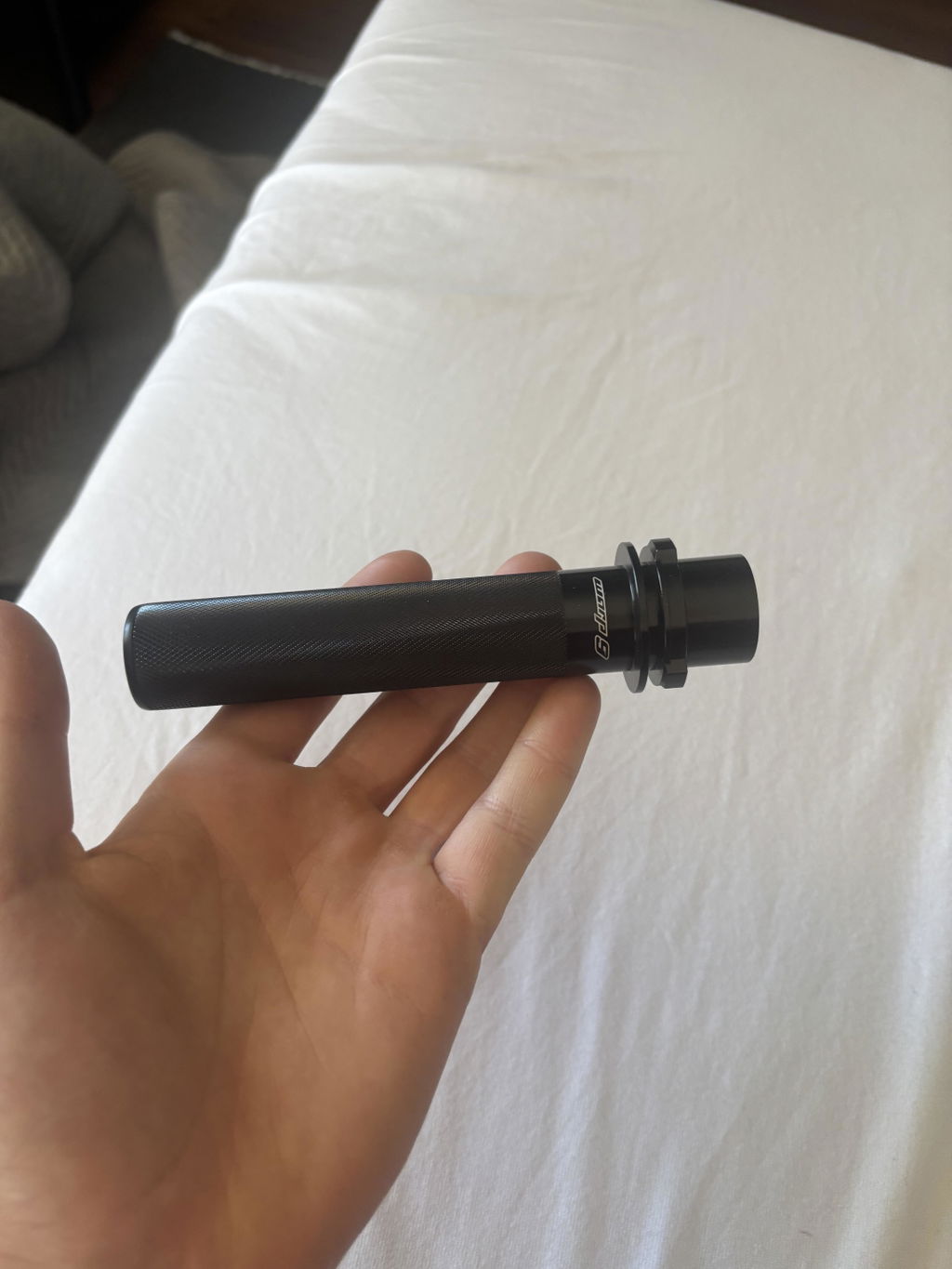
- Warp 9 throttle tube — the standard tube on the Ultra Bee is plastic and permanently vulcanised to the grips, so you cannot replace the rubber on its own. A 7075-T6 aluminium tube with PTFE bushings solves that and gives even resistance through the whole travel. One of the cheapest worthwhile parts on the bike.
The order in one paragraph
Controller → suspension → (optionally) motor → wheels to suit how you ride. At every step, check whether the battery, brakes and drivetrain can keep up with what you have just added. Modifications done out of order usually end with the new part unable to show what it can do.
Frequently asked questions
Can an Ultra Bee be registered for the road after tuning?
No. Modifying the drivetrain rules out road approval. These bikes are ridden off-road and on private land with the owner's permission.
Does the EBMX controller work with the standard Ultra Bee motor?
Yes. The X9000 V3 supports the standard Ultra Bee motor, as well as EBMX XLB, XUB and XTA series motors and maps for over 30 other motors.
Where should I start on a limited budget?
With the controller, as long as power is your problem. If the bike is already fast enough for you and it is the suspension wearing you down — start with spring choice and settings; that is the cheapest step in the whole of tuning.
All the parts: Sur-Ron Ultra Bee, EBMX, suspension.