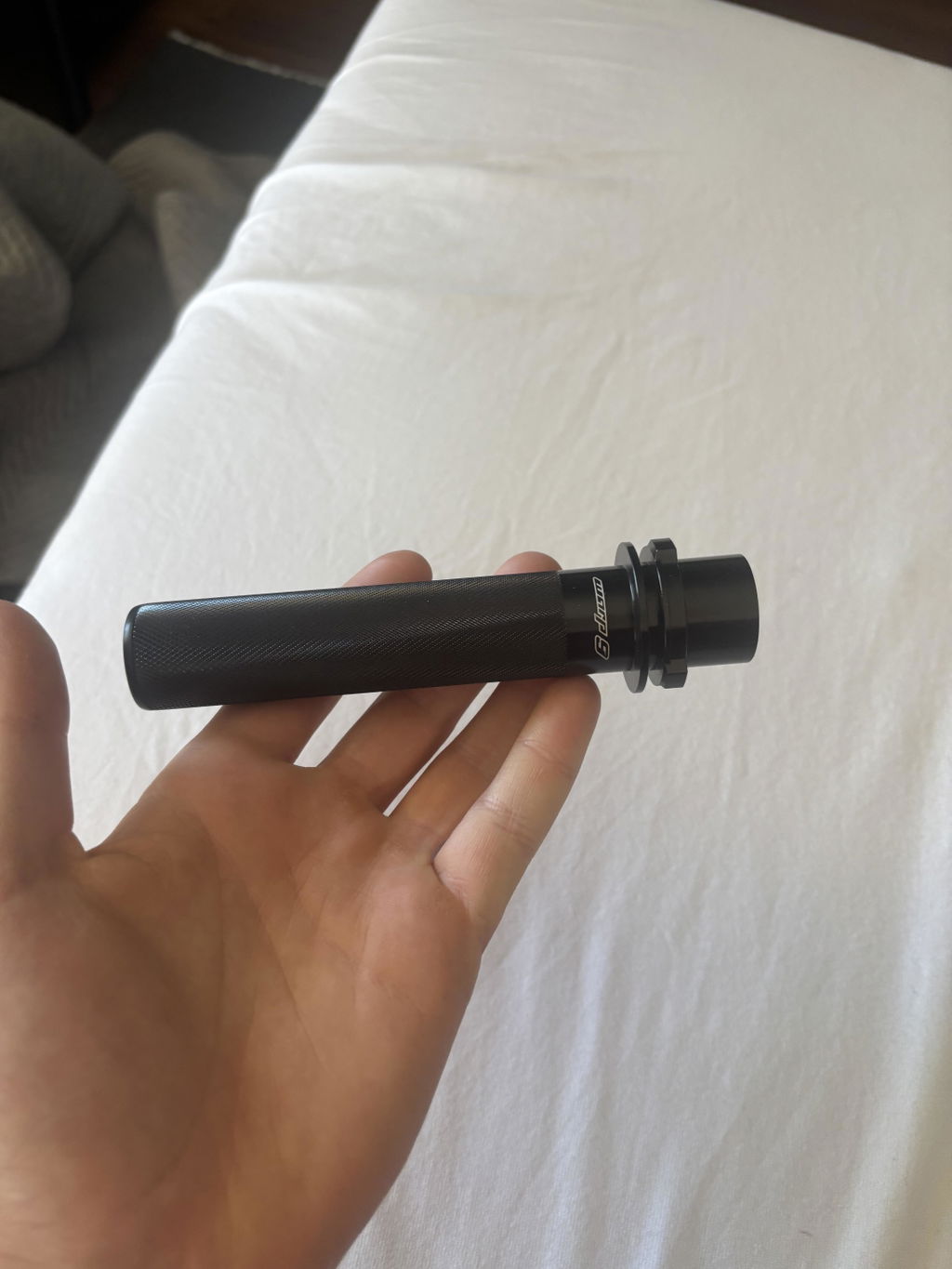
On a Sur-Ron Light Bee, power goes from the motor to the rear wheel through two stages: first a toothed belt from the motor to the intermediate shaft, then a chain from that shaft to the wheel. That first stage is the weakest link in the whole drivetrain — and it is the weakest link deliberately.
Why the manufacturer fitted a belt
A belt has real advantages: it runs quietly, needs no lubrication, is light and doesn't make a mess. At standard torque it works very well — which is why it is there.
The problem only appears once you change the equation. An electric motor delivers full torque from zero revs, with no clutch and no delivery that builds up. The belt takes a torque hit in a fraction of a second. At the standard 6–8 kW that still sits within the design margin. At 20, 30 or 50 kW it no longer does.
How to tell the belt is skipping
The symptoms build up gradually and are easy to dismiss:
- A single "jolt" on a hard launch — for a fraction of a second the revs rise and the bike doesn't accelerate
- A characteristic noise — a short, dry crack from under the drive cover
- More frequent episodes under load — on climbs, pulling out of a corner at full throttle
- Visible wear — rounded-off edges on the belt teeth, rubber dust around the pulley
One skip doesn't destroy the belt straight away, but each further one shears the teeth more. A snapped belt out in the woods means exactly what it looks like: the ride is over and you are walking the bike home.
What switching to a chain gives you
The Warp 9 Warp Drive converts the first drive stage from belt to chain.
- A higher strength threshold — a chain takes the torque shocks that shear belt teeth
- Predictability — a chain wears gradually and signals it by stretching, rather than failing suddenly
- Serviceability — you can replace the chain and sprockets separately, and more cheaply than a complete belt set
- Gearing changes — you can choose sprockets for speed or for torque
Set against the price of a controller or a motor, the kit is a minor item — a small fraction of either — and it is the condition for those parts being able to work at all. See the current price on the product page.
What to expect on the other side
Honestly: a chain is louder, needs lubricating and cleaning, and will make a mess of the swingarm. On an electric bike, with no combustion engine noise to hide behind, you hear the difference in volume clearly. That is the price you pay.
When to do it
The simplest rule: along with the controller or the motor, not after the fact.
- Staying on the standard motor and standard controller → the belt is enough, leave it alone
- Fitting a more powerful controller → plan the conversion for when you run higher power settings
- Fitting a different motor → the conversion is compulsory. At the 52 Nm the EBMX XLB-60 Race produces, the standard belt is not a solution
- Riding mainly on climbs and in sand → consider it sooner, even at moderate power — the continuous load there is higher than average
What else is worth doing at the same time
Chain guide
The EBMX rubber chain guide guides and cushions the chain along the swingarm. A small, inexpensive part that does three things: it damps the chain hitting the swingarm, keeps the chain on one line instead of letting it slap from side to side, and protects the paint and the aluminium of the swingarm. That last function matters more than it sounds — chain cuts in a swingarm cannot be undone.
The guide fits EBMX swingarms. Got the standard swingarm or one from another manufacturer? Message us before buying and we'll check the fit.
Swingarm
On very powerful setups it is worth going a step further. The EBMX swingarm is 60 mm longer, which translates into better rear-wheel traction, more stability at high speed and smoother landings off jumps. It takes 54T–58T and 64T sprockets.
Important with the swingarm: because of the longer design the standard chain will be too short — you need around +12 links over the standard length, and the exact length is matched to the sprocket you choose.
There is also a version for the E-Ride Pro SS.
Frequently asked questions
Is the conversion reversible?
Yes — you can go back to the belt setup if you keep the original parts.
How often does the chain need servicing?
Clean and lubricate after every wet or sandy ride, and check the tension every few outings. A neglected chain wears the sprockets far faster than it wears itself.
Will a chain add power?
It won't add any, but it will let you use what you already have — without losses to skipping and without the risk of a failure halfway through a ride.
Do I have to change the gearing?
You don't have to, but you can. That is one of the advantages of a chain — swapping a sprocket is the cheapest way to shift the bike's character towards torque or towards top speed.
Related: choosing a controller, choosing a motor, the Warp 9 collection.